Tuesday, May 30, 2006

New Uttermost Website

From Home Accents Today, Uttermost, a leading accessory and lighting manufacturer, unveiled an easy-to-navigate virtual showroom on its new Web site at http://www.uttermost.com/.
The new Uttermost virtual showroom is a great example of where art and technology have come together to create the ultimate shopping tool that meets the business needs of today's retailers.

The site has sophisticated yet easy-to-navigate search functionality to enable the user to quickly narrow down and access specific accessory categories and/or product information. They can access specific information such as product sizes or specific finishes and styles.

[...]

The Web site also caters to consumers and the company's internal sales force. Consumers can visit the virtual showroom to find out information on the newest home accessory products, and get tips from designers.


Speaking about Tips from Designers, The Uttermost Website has an informative piece about Designer Tips for Lighting and Lighting Fixtures. Some of the topics covered:

My room seems too big/small…. how can lighting help?

How can I use lighting to show off the beautiful decorative objects in my home?

What general rules should I follow to light the master bedroom?

I have a home office… how should I light it?

We carry the Uttermost products in the Landfair Furniture + Design Gallery. Take a look at the virtual Uttermost website. We can drop ship any style lamp or accessory to your home or office.

Bev & Mike

Monday, May 29, 2006

BermanFALK Acquires LDC Design Studio

From FURNITUREToday comes news that BermanFALK has acquired the rights to produce the furniture designs of California-based LDC Design Studio.
LDC, a 10-year-old contemporary bedroom, dining and occasional furniture producer based in Palm Springs, will stay in business, and owner Joel Bessaules will continue to provide input on design, but its collections will be made at the Bermanfalk plant in Langley, British Columbia, said Gary Berman, vice president of marketing and sales for Bermanfalk.

He described LDC as a niche-oriented manufacturer with a regional presence in the U.S. Southwest, whose looks complement Bermanfalk designs.

The company hopes to expose LDC to an international customer base, Berman said. He said Bermanfalk also wants to develop relationships with what he described as LDC’s loyal customer base among designers.

“They’ve obviously got some terrific product. It’s very well styled and works along with our product well,” Berman said.

He said the purchase was completed in late February, and did not disclose a price.

Last year, Bermanfalk acquired Vancouver-based HOM Furniture & Design, a high-end company targeted to metropolitan markets. Berman said the goal eventually is to market the three companies under one brand name.

The LDC Design Studio bed in Espresso finish pictured above is part of the Chandler collection and comes in Classic Finishes of Amber Rift Oak, Chestnut Rift Oak, Dark Walnut Rift Oak, Espresso Rift Oak, and Ebony Rift Oak. In addition, there are Premium Finishes of Birdseye Maple, Zebrawood, Macassar Ebony amd Wenge.

With the loss of Dinec' bedroom furniture line, a result of the discontinuation as a result of Dinec's reorganization from Chapter 11, Landfair Furniture + Design Gallery will be pleased to offer LDC Design Studio as part of the BermanFALK quality furniture offerings.

Bev & Mike

Sunday, May 21, 2006

Palecek Outdoor Furniture


From Copley News Service,
Indoor-outdoor furniture should be weatherproof, stackable,
by Christine Brun.

If your place is small and has little space for storage, look for furniture pieces that work as well inside as out. That way, you expand your entertaining capability for every season.

Shopping for such indoor-outdoor furniture requires patience and restraint because some beautiful garden furniture would look out of place indoors. And the ubiquitous white plastic chairs available at discount and home-improvement stores definitely would not work.

Still, some of the features found in both of those options are worth trying. You need seating that is weatherproof and pet-friendly. Stackability is an added plus.

Palecek's Patio Stacking Chair is one handsome possibility. The body of the cafe chair is woven with high-quality UV-resistant plastic. A special coloring technique is used to create the wickerlike appearance over a frame of bent black rattan.

Investigate your finds carefully so you aren't in for a surprise when they are exposed to the elements. Although the Palecek chair is constructed partly of natural rattan, which gives the chair its genuine look, you might not want to leave it outdoors year-round. This chair would do fine for the season, and you'll get extra use if you buy plastic covers for all of your outdoor furniture.

Alfresco dining is also pleasurable in another Palecek offering, an aluminum-framed chair covered in an all-weather woven synthetic material that mimics the look of natural rattan peel. Aptly named Al Fresco Metro Chair, it is also conveniently stackable and has a more contemporary feel.

Shop with your pets in mind, too. Puppies chew on just about anything, so a metal model might be better for the household with pets.

Try to locate outdoor chairs that will be compatible with your existing indoor pieces. For example, if you already have wicker indoor dining chairs in a natural color, the Patio Stacking Chair would have the woven element in common.

Your eye will read the texture and color first before the differences in design detail hit your brain. In this way, whether you are inside looking out or outside looking in, if the colors and styles are compatible, the visual impression will be that the space is contiguous.

Another way to achieve this connection is to continue the type of flooring from inside to out.

The same rule also applies to your tables. A wood dining surface won't endure the weather, but make sure other finishes are visually similar enough to allow for design flow.

Christine Brun is a San Diego-based interior designer, member of ASID and author of Big Ideas for Small Spaces. cbaintdes@aol.com or to Copley News Service, P.O. Box 120190, San Diego, CA 92112.

Landfair Furniture + Design Gallery carries Palecek indoor and outdoor furniture and accessories. We carry some items on our showroom floor have many more in catalogs that can be ordered, some in a variety of fabrics and leathers.

Bev & Mike

Thursday, May 18, 2006

Decorating Dead Zones

It's Bridget Otto Thursday and her column today in The Oregonian's Homes & Garden section, concerns those hard to decorate little areas, she calls "Dead Zones".
Every house has one or two. Sometimes there are more.

We're talking dead spots, those puzzling areas that are often not furniture-friendly but look vacant without something. It can be a small landing on a staircase or a transition spot from one room to the next.

Mine's in the entryway. First off, there's no electrical outlet nearby, so a quick fix of adding light is out. Secondly, there is already a table off to the other side of the entry, so an additional table looks redundant and not very clever.

I've had a chair there for some time. Granted, no one sits in the chair, but it fills the void and acts as a catchall for coats and purses -- sometimes a good thing, sometimes not. I've lobbied for a decorative coat rack, but my husband thinks it, too, will become an eyesore filled with coats and umbrellas and purses. He may be right, but I'm not convinced.

A chair with some architectural flair and a tall back might fit the bill, but I haven't found it yet.

"You want something interesting, something different or edgy," says designer Beverly Landfair of Landfair Furniture + Design Gallery in Southwest Portland. Landfair, like many designers, sees these dead areas as great challenges and places to accessorize the home.

She suggests adding mirrors to make the area appear larger or brighter. She's also a fan of chests, available now in every style from traditional to contemporary. The end of a hallway is a great place for a tall chest, which can do double duty as storage as well as pull the eye down the hall, creating a focal point.

Like Landfair, designer Diane Keaton, of Diane Keaton Interiors in Beaverton, likes dead-space challenges.

"These are my favorite areas to deal with," she says.

To bring life to a dull spot, Keaton often adds artwork, from sculptures to paintings to photo groupings. For one client who had moved into a condo, Keaton punched up wall space above the kitchen sink with a large photograph that both harmonized with the Asian-inspired decor and provided an outdoor scene for an otherwise visual dead end.

In the hallway of her own home, Keaton filled a drab spot with two framed photographs and set a small stool with an upholstered seat under them. She balanced that at the opposite end with more framed photographs and a plant in a pretty pot on the floor.

In another client's home, she filled a vacant ledge with a grouping of three large, matching vases.

"It's a wow," she says.

Groupings of little things bore Keaton a bit. She operates on the less-is-more design philosophy -- fewer items, but big ones. "You want something to look at."

If the dead spot can be isolated, go for it and treat it differently from the space around it, says designer Kimberlee Jaynes. Make it pop with paint and/or bright objects or shiny surfaces. If it's possible, paint the ceiling in that area with a bronze metallic paint to reflect light.

If the space is dark and you'd like to hang artwork, Jaynes suggests frames that come with battery-powered lights, available at some Portland-area frame shops.

Jaynes, who owns Kimberlee Jaynes Interior Designs in Northwest Portland, thinks in terms of paint, texture and artwork when faced with "any dingy hole." All good ways to get ideas flowing.

Me? For starters, I'm going to beg my sweet husband to put in an electrical outlet to bring that dead spot to life.

Bridget A. Otto: 503-221-9527; bridgetotto@news.oregonian.com

Bev & Mike

Thursday, May 11, 2006

Synthetic or Wood, How's Your Deck?

It's Bridget Otto Thursday and today Bridget writes about outside decking in a two part article. In the first part, she writes about choosing decking, wood or synthetic?
Synthetic decking, once the ugly stepchild that looked like the plastic used to make it, has grown up and is becoming a popular deck-building material.
One big advantage of synthetic over wood is maintainance
Although not zero maintenance, synthetic decking is very low maintenance -- especially when compared with a cedar deck that needs to be stripped and sealed yearly.
The second part of the article concerns inspecting your existing deck for safety.
Properly built and maintained, a deck will provide years of enjoyment. But as the years go by, weather and use can erode the deck's structural integrity.
Then Bridget goes on to tell us some things to look for that may tell us if we need to replace our deck or make repairs.

Clear debris. Debris acts like a sponge.... Be especially sure that there is no debris buildup where the deck meets the house.

Check for dry rot. Test wood for softness by poking it with a nail or a screwdriver.

Check the ledger board where the deck is bolted to the frame of the house. Bolts should be staggered one up and one down.

Make sure all fasteners are secure by giving railings and balusters a good shake.

Check that support posts are secure in their footings.

Bridget A. Otto can be reached at bridgetotto@news.oregonian.com

Bev & Mike
Landfair Furniture + Design Gallery

Wednesday, May 03, 2006

10 Tips: Carpet Colors

From House Beautiful, 10 Tips: Carpet Colors By carpet and textile designer Christine Van Der Hurd.

1. Go with your gut feeling when choosing a carpet. I think color is more important than design; if you don't love the hue, the pattern, however pretty, won't matter.

2. Consider whether you want your carpet to be a focal point of the room or to blend in unobtrusively. Highly patterned, brightly colored carpets obviously belong in the former category.

3. If possible, choose your carpet before deciding upon paint, upholstery and curtains. The colors in your carpet can provide inspiration for the color scheme of an entire room.

4. Before making a decision about carpets, think about whether dirt is a factor. Do you have small children or dogs? Do you entertain a lot? More pattern can help to hide daily wear and tear.

5. In rooms with lots of pattern and texture, it's generally best to choose a single-color floor covering ‑- but it doesn't have to be beige. Pick out a color you like from the curtains or cushions.

6. If you're trying to find a carpet that will work with fabric and colors already in place, consider custom design. It's not necessarily much more expensive than off-the-rack, and you will have a unique, perfectly matched piece.

7. Runners on stairs can introduce color and texture to the bland environment of a hall or staircase. A cotton dhurrie runner, for example, could be perfect for a beach house.

8. Offices don't have to have wall-to-wall industrial carpeting. An interesting rug that you like to look at can make the workplace far more inviting.

9. Children love color, so don't be afraid of using it in their rooms. Choose a carpet that is soft and comfortable to sit on, as they tend to really use the floor while playing. Sometimes the design on a carpet can even feed into activities and games.

10. If you don't want a pattern, but like a textured look, consider a natural yarn that takes dye unevenly. Another option is to look for carpets that leave the fabric knots looped, or uncut, which can add wonderful luster and texture.


We have many friends in the carpet business at Macadam Carpets, Trinity Carpets and custom carpet designers, to name a few. We would be happy to make introductions for you to insure you get the best service.

Bev & Mike
Landfair Furniture + Design Gallery

BermanFALK Dining Table with Classic Lines

Landfair Furniture + Design Gallery recently added BermanFALK and I was searching for a way to show the stunning dining room table with a four legged curved pedastal.


(Click on Image for larger picture)

You can see the BermanFALK table tends towards the traditional, has classic lines, but is “still modern”. The chairs have contrasting horizontal slats an interesting architectural feature. In this case they have chosen a striped mix of two shades of cream and mocha.

Bev & Mike

Dining Room Furniture Guide

Furniture WORLD has an informative article about Dining Room Furniture. While it is product knowledge for salespeople, it gives a good insight into how to spot quality.


Dining Chair Quality
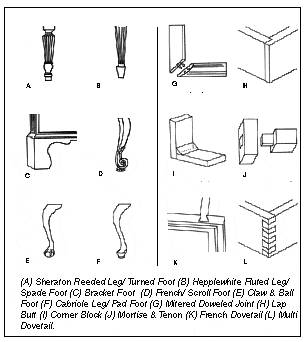
Quality dining chairs feel heavy, substantial and rigid. Chair quality is easy to see and demonstrate since every rail, post and joint is exposed and easily examined.
Chair comfort is one of the most important indicators of good design. You should demonstrate how the design of the seat, back and arms contribute to seating comfort. Make sure your customers sit in each chair they consider purchasing.

Chair strength is extremely important, since dining chairs often take more abuse than any other piece of household furniture. They get knocked over, stood on, spilled on and balanced on their back legs. Poor construction integrity resulting in loose joints will certainly cause customer dissatisfaction, or injury.

Fortunately, most dining chairs are very well made. Box seat wooden chairs often have mortise and tenon joints or dowel joints joining leg posts, stretchers, back posts and rails. Corner blocks are used at stress points to strengthen the seat and the joint, especially where stretchers are not used. All joints should be rigid and the chair should not wobble.

Sloppy joinery and the use of filler to smooth out joints is an indicator of poor quality, as is the excessive use of nails and screws to stabilize a wooden joint.

Different wood species do not expand and contract at the same rates. This may cause problems at joints where two species are joined - but not necessarily. There are many fine windsor chairs, for example, dating from the mid 18th century which combine Pine, Hickory, Oak, Ash and others in the same piece.

Steam bent parts will generally be stronger than shaped parts or those made from several components joined by finger and laminated joints.
Finish quality can be judged by examining places near joints or carvings that are hard to reach and so require hand sanding - especially on chairs with posts, pierced splats, slats or turned parts. These areas should be smooth, evenly stained and free from excess glue.
Those seeking knowledge about dining room furniture should know that there is a fine glossary at the end of the article. The entire dining room furniture guide contains 16 pages of information on construction, styles and terms. The guide sells for $1.95 and can be purchased by calling FURNITURE WORLD Magazine at 914-235-3095 or email education@furninfo.com.

Bev & Mike
Landfair Furniture + Design Gallery

Sunday, April 30, 2006

Feng Shui Made Simple

House Beautiful has an interesting section in their magazine entitled Feng Shui Made Simple Feng shui (pronounced "fung shway") is the Chinese discipline that teaches us how to attract and enhance our life energy (called chi) according to how our homes are arranged. Do you know how to attract or enhance the Chi in your home and life?

1. What is a bagua and how do I use it?
A bagua is a feng shui road map. It divides your home into nine sections (called guas) that correspond to the nine main areas of your life. The graphic below is a representation of a bagua. Your front door opens up into the skills & knowledge, career or helpful people gua. From there, you can divide your space up into nine parts and find each of your other guas. Learn more about the bagua here.


2. What part of my life would I like to change?
This is the easy part: Just click on the area you need help with below.
So I clicked on the Prosperity gua and I was amazed at some possibilities of prosperity ch'i zappers:
Clutter: Michael's office is especially cluttered. Get rid of it and the dust that has collected.

Leaks and peeling paint: If the ceiling is leaky and peeling away, so is your money.

Toilets: Toilets pull energy down and away. Be sure to keep the lid down as much as possible.

Broken stuff: If it's broke, you probably are too.

Dead or withering plants:
Anything obviously decomposing is not holding the energy you want in this area.

Trash can: Like the toilet, takes energy away.

Improper prosperity symbols: Art that depicts items in a withering or decomposing state (old rusty chairs, sad or poor people) or reminders of your college days when you were flat broke should not be displayed here.
Now let's look at chi enhancers:
Purple, red and green:

Symbols of wealth: Actual money, gold or stock certificates all play well in this corner of the house.

Jewels:

Symbols of "having it all": Pictures of the kids or pets if they make you feel like you have it all work well here. Collages or photos of items that you would like to have do as well -- just place them here and pretend that you have placed your order for them. When the order is up, you will receive them. Just remember ... be careful what you wish for!

Healthy plants: Grow money in your accounts by growing a plant here.

Moving water: Get money moving by creating a flow in this zone.
This feng shui thinking just feels right to me. Check out the guas of your life and let me know if the chi zappers and enhancers seem right to you.

Bev & Mike
Landfair Furniture + Design Gallery

Friday, April 28, 2006

StyleCraft adding Terry Redlin line

From Home Accents Today,
Well-known artist Terry Redlin is adding lamps and accessories to his furniture line at this High Point market. The new lighting and accessories program is debuting with StyleCraft Home Collections. Redlin’s furniture is with Austin Gray.


(Terry Redlin Amber Waves of Grain)

For more than 45 years, Redlin has captured the American spirit on canvas through his nostalgic scenes of rural America and wildlife. He was voted “America’s Most Popular Artist” for eight consecutive years by U.S. Art magazine. Redlin relies on the same look in his home furnishings designs.

“We’re excited to be launching the Terry Redlin program since Americana-inspired looks are not currently a major part of our product portfolio,” said Mike Kennedy, StyleCraft president.

Lighting and accessory groups to be introduced include themes directly inspired by Redlin’s paintings including the American pioneer, the outdoors and wildlife, and the West. Rich patinas and a variety of materials including wrought iron and faux leathers provide a look of rustic elegance that will help bring Redlin’s vision of Americana into consumer’s homes.

Hernando, Miss.-based StyleCraft Home Collection is combining all its High Point showrooms under one roof at 130 S. Main St. where the Redlin collection can be seen.

This spring, Austin Gray will introduce a fourth Terry Redlin bedroom group called Golden Retreat. This new group is constructed with blends of mappa burl and prima vera veneers over alder solids and features traditional styling with a golden finish like the vivid sunset over a country lake featured in Redlin’s painting. Line extensions for the Boulder Ridge collection include dining room, home office, and home entertainment furniture. The American Portrait collection is being expanded to include a bar and bar stools. Austin Gray also offers Terry Redlin leather upholstery and accent chairs.

Landfair Furniture + Design Gallery carries Stylecraft lamps and now will have access to Terry Redlin's influences.

Bev & Mike

Thursday, April 27, 2006

Pull a fast one by Bridget Otto

Cabinet knobs change out in a snap

It's Bridget Otto Thursday in the Homes & Garden section of The Oregonian. Bridget writes about the simple idea of changing your cabinet knobs in the kitchen or bath, changes the style of the room or freshens the look.
Oodles of options line the aisles of home improvement stores, while some artsy boutiques carry limited one-of-a-kind creations. Pages of Web sites with names such as coolknobsandpulls.com, interknobs.com and myknobs.com pop up on a search. Chown Hardware alone offers 3,200 varieties. Prices range dramatically.

Gerry Worrell, who works in the hardware department at Lowe's in Tigard, says silvery satin nickel and blackened antique bronze are the two finishes most popular now. You'll want to complement -- but not necessarily match -- the other hardware in the room, from faucets to doorknobs.

Bridget offers some tips for selecting pulls:

Save yourself some trips to the store and time by carefully measuring or even taking a drawer to the hardware store.

In making your selection, consider the size and style of the cabinet.

But don't be hemmed in by convention. Consider what it is you're trying to achieve.

Now that you've chosen the perfect pulls and knobs, make sure that you don't go home without the right screws.

If you are redrilling to accommodate a new pull, buy a drawer-pull template.

Bridget ends by saying
And, because the change is so simple, you don't have to live with this look forever. The possibilities are endless.

In our kitchen we are only limited by our creativity and...our budget. These knobs aren't cheap. Bridget offers a number of websites catering to cabinet pulls that can help you work out a budget.
Bev & Mike
Landfair Furniture + Design Gallery

Friday, April 21, 2006

Interior Designer: Kathia Emery

There is a very nice article by Cathy Lamb in the Homes & Gardens section of The Oregonian entitled delicate Merger. It features local interior designer Kathia Emery. Emery describes her decorating style as "traditional, with a strong emphasis on country French and English-with a romantic overlay. She recently combined households with ex husband of 2 1/2 years James Kahan. They had divorced, she remarried for 32 years until her husband died in 2004. In 2005 they hooked up again after Reed College invited Kahan to speak. They plan on remarrying on December 15th.

Kathia Emery has some tips for Combining Households Gracefully:

Buy a Home together - Then it's not one person moving in on the other, and there are no "ghosts" of the ex or deceased spouse.

Let the style of the home dictate what to keep - If you live in a Colonial, toss the retro stuff.

Sort, toss, give away, sell - Then look at your stuff and do it again. Two households morphing into one equals clutter.

Compare the "weight of importance" - If one person feels strongly about something - a painting, for instance - let that person win.

If there are duplicates, give one away - keep the pieces that are timeless and will stay in style forever.

As for photos - Children will need photos of the family, including the parent who is no longer in the home. Family photos from both sides can be hung together, although Kahan recommends separate family photo walls. Otherwise, "It's like you're trying to make a melting pot that won't melt.

Buy a new bed and bedding - Absolutely.

Accomodate, compromise and give in - Don't come to blows over a coffee table.

Hire a professional - designer or organizer to act as intermediary

Before Michael and I were married, he had been married twice before. (Third time's the charm) He wrote this poem about his experiences:

Moving Day


I travel light
when I move in with a lady
I don’t disturb her décor.
only problem…you don’t know I live there.

I am a new male model American
my ex-wives are housekeepers.
I move out they keep the house.
What I own fits in your standard four door sedan.

It’s moving day back to the same apartment complex
with the same floor plan…
that way I know from past experience
where to put my hairdryer.


As we baby boomers age, there will probably be more circumstances where households are combined. Kathia has some great advice.

Bev & Mike
Landfair Furniture + Design Gallery

Thursday, April 20, 2006

Gas-powered Tankless Heaters

It's Bridget Otto Thursday and today she writes about Going tankless, tankless water heaters. In a follow up to her December article about tankless water heaters, Otto writes
Seems there's no market for electric systems here. But there is for gas-powered, and those readers with gas-powered heaters felt I'd given the product short shrift.

Now, knowing what I know, I agree with them. But my bottom line is still the same: Tankless water heaters are wonderfully convenient and energy efficient. But if your goal is to save money -- an aspect highly touted by manufacturers -- chances are good you'll be disappointed.

[...]

The Energy Trust report sees new homes as the best niche for tankless heaters but notes that many contractors and builders aren't familiar with them.

In existing homes, the report says, "the costs of physically accommodating their installation can add considerable expense."

Bridget A. Otto: 503-221-8527; bridgetotto@news.oregonian.com


Bev & Mike
Landfair Furniture + Design Gallery

Wednesday, April 19, 2006

IP Focus: Susanna Bassanini

The American Society of Interior Designers (ASID) is a community of people—designers, industry representatives, educators and students—committed to interior design. Through education, knowledge sharing, advocacy, community building and outreach, the Society strives to advance the interior design profession and, in the process, to demonstrate and celebrate the power of design to positively change people’s lives. Its more than 38,000 members engage in a variety of professional programs and activities through a network of 48 chapters throughout the United States and Canada.

The Oregon Chapter has chosen to focus on Susanna Bassanini, owner of Carpet Expressions, as their second quarter Industry Partner. We thought the background of Bassanini was sufficiently interesting, that we wanted to reprint part of the quarterly newsletter.


click to enlarge

Susanna Bassanini is currently Board Member of ASID as the Communications Director in charge of the newsletter, news flash, website and public relations. She has extensive experience in information technology with a degree in Management Computer Systems and a life, prior to Carpet Expressions, managing a team that tested web sites and software systems that gave management tools to run large enterprises more efficiently.


click to enlarge

Susanna (sounds like sooze ahna) has a need for the mathematical, linear thinking, as evidenced by her mathamatics minor in college. However, she had a need for the creative as a counterweight. She nourished that creative side, as a corporate IT person, by taking lots of watercolor classes. Still feeling unfulfilled, she wrote down four goals: she wanted to be in design; she wanted to be involved in color; she wanted to work in or near home; and she wanted to be her own boss. She took a class in rug crafting and she was on her way.

Now she has her office in her home in the Multnomah Village neighborhood on almost 13,000 sq. ft. lot and a workshop in the garage. Not to ignore the mathematical side, she uses those skills measuring, ordering carpet, figuring out repeats, running her business. She has a comfort with numbers. Susanna’s IT background is helpful as she built and maintains her own website, carpetexpressions.com. Her watercolor background is helpful as she designs the rugs that she fabricates She and her husband Augusto, spend many hours landscaping and entertaining in their yard with their chocolate lab, Shelby. She’s been married 7 years to Augusto who’s from Italy. They frequently travel to visit his family in Milan, Italy.


click to enlarge

Susanna said of her position as board member of ASID, ASID is a volunteer organization and offers a number of benefits to designers and IPs. She feels a duty to give back to the organization and encourages others to do the same.

She feels strongly that designers need a web presence and ASID has an inexpensive program that gets your web page connected to the asidoregon.org site. It’s a great way to show prospective customers your portfolio.

Susanna is a vivacious and energetic young woman who enjoys spending time with her family, friends and pets. The DVR is her favorite piece of technology, so she doesn’t miss an episode of 24 or American Idol, and can skip the commercials. Her biggest business goal is to have a larger workshop.

Carpet Expressions
Phone: 503.348.5973

Bev & Mike
Landfair Furniture + Design Gallery

Bar-B-Qued Pork Chops

From MercuryNews, Timing is everything in cooking pork chops
So you're standing at the meat counter on your way home from work. The pork chops look terrific, and they're priced right for a family dinner -- but how are you going to cook them?
Donna Deane of the LA Times recommends
...four quick steps: Season the meat, sear it, make a sauce as you deglaze the pan and finish the meat in the sauce.
Michael loves bar-b-qued pork chops, either the thick cut or bone-in. His secret is to season the meat on both sides with Williams-Sonoma, Gray Sea Salt with Five Pepper Blend from ile de Re', France about a half hour before cooking. Before turning on the barbee, spray or wipe grill with olive oil. Turn on high and sear both sides of pork chop, then turn down heat to medium-low and cook with indirect heat for 10 minutes on each side or when white in the middle not pink.

The seasoning gives the meat a slightly salty taste similar to ham. Besides the peppers and sea salt the seasoning has coriander, thyme and rosemary. It is delicious!

Bev & Mike
Landfair Furniture + Design Gallery

Monday, April 17, 2006

Two New Blogs

I've come across two new blogs. For a long time there have been few blogs oriented to the design community. Now we have Natural Area Rugs blog and ArtCorner.com blog.

Natural Area Rugs is written by
Mike Dennis, publicist for Natural Area Rugs, posts about the inner workings of Natural Area Rugs, a national leader in natural area flooring. Topics include business strategies, new products, and information on natural rug materials including sisal, seagrass, jute, bamboo, and wool.
Dennis has several articles you might enjoy including:

Growing Popularity of Jute Rugs
Interior Designer: Right Area Rug Pulls a Room Together
Area Rugs Complement Wood Flooring

Many of the articles promote the Natural Area Rugs business, however if these articles aren't the exception, it will benefit us to visit the site.

ArtCorner.com is started by Amitai Sasson.

The blog’s features will include: daily postings from OverstockArt’s clients and personnel on happenings and inside information that comes across their desks; comment threads from avid readers among the OverstockArt community and Interior Design industry; and live links and references to the best ArtCorner-related blogs and web sites on the Internet.
Some selected articles are:

10 Tips To Refresh your Interior Design
The most amazing Gauguin I have ever seen!
A Blank Canvas: A brief consideration of Modern Design

I am adding both blogs to our blogroll.

Bev & Mike
Landfair Furniture + Design Gallery

Wednesday, April 12, 2006

Wood Floors

In case you missed it Pure Contemporary has a short article on Jan. 30, 2006 reproduced here entitled Types of Wood: How to Choose


It's a question many of us ask ourselves before changing the floors, cabinets and furniture in our home - what wood should I use? Can I mix maple cabinets with oak floors? Is Teak the current wood of choice? Which wood is the warmest?Wood

Sunset Books helps define wood types, cuts, installation and more.

Wood Floors
Sunset Ideas for Great Floors

When you choose wood, you're choosing one of the warmest, most time-tested, and versatile flooring materials. And one that looks better with time.

Types of wood
Many wood species are used for flooring. Each one has its own natural color, markings, and advantages.

Oak flooring comes in either white or red. The color of white oak runs from a creamy white or light brown to medium brown. It's a bit harder than red oak, has smaller markings, and has a more uniform appearance. Red oak is reddish brown, and its open grain makes it somewhat porous.

Maple flooring runs from pale white to light reddish brown. It has a uniform texture and closed grain and is very hard, harder than red oak.

Pine, considered a softwood rather than a hardwood like oak or maple, was commonly used in early American flooring because of its natural stability. Longleaf heart pine (on a par with red oak) and southern yellow pine are the hardest of all pines. Minor dents and dings will happen over time but tend to enhance a floor's character.

Bamboo flooring is similar to oak in dent resistance and is much more dimensionally stable than most wood flooring. Because bamboo is harvested from grass and rejuvenates itself to maturity in three to five years, it is environmentally friendly. It comes in both vertical and flat-grain patterns and in a light natural and a darker amber color.

Cherry is appreciated for its warm reddish coloring, straight grain, and smooth texture. It looks sleek when sanded and finished and is frequently used for cabinetry. Of medium density, it is dimensionally stable upon kiln drying.

Mahogany, an extremely durable high-density wood, has a deep reddish brown color and very fine graining. Mahogany encompasses a few different timber species. It was first discovered in the West Indies but now, due to sustainable harvesting, comes from Mexico, and Central and South America.

Teak, similar in strength to oak, is naturally resistant to insects, fungus, termites, and temperature shifts. Recently brought back into vogue through sustainable sources, it has a distinct shading that varies from yellowish brown to dark golden brown. Its grain runs straight, although its texture can be uneven.

Bev & Mike
Landfair Furniture + Design Gallery

Sunday, April 09, 2006

Do You Sleep With Your Pet?

Bedtime's gone to the dogs by Gina Kim

They snore. They scratch. They shed. They paw at the sheets and have no sense of personal space.

But people love their dogs anyway - and increasingly, they are letting them into their beds.

About 21 percent of dog owners admit to sleeping with their pets regularly while another 16 percent say their dogs sneak into their beds at least once in a while, according to a survey by the American Kennel Club.
They are more than just pets, they are family! America may be looking at bigger bedrooms and more king sized beds.

Bev & Mike

Saturday, April 08, 2006

"Know Your Client" Professional Paper from ASID

It's Saturday, April 8th. It's a quiet morning, so I thought I would pass on some information I received from ASID.
How many times have you thought, "if only I could get inside my client's head so that I could do a better job," or for that matter, get the job!
There are some new professional papers available to members of ASID, for free, and priced at $15 to $25 apiece, for non-members. One paper that caught my eye was entitled Know Your Client: Fundamentals for Effective Relationships< (non-members $15 plus $1.50 for shipping). I downloaded the PDF and want to share some tidbits with you.
The paper is based on a series of studies beginning in 1996. Each study asked interior designers what they believe clients value in working with a designer and then asked clients the same questions. The results show where interior designers and clients are "in sync" and "out of sync" as well as where values change over time.
Here are a few of the things that stood out for me:

Clients and designers agreed that knowing the client was very important as was consults, doesn't impose interior designers taste on the client, Where they differed was emphasis on knowing the latest design trends. Clients were less concerned about this aspect.

Another difference between clients and designers is emphasis. Both placed the same emphasis on handling the ordering and using the interior designer as a resource. The client was less interested in how it gets done.

This last one surprised me. Both client and interior designer were equally concerned that the interior designer was qualified, but the client was less interested in the designers portfolio of prior work. I think that goes back to the client wanting to feel unique and understood and having their needs met.

I have barely scratched the surface of the paper. I invite you to download the paper or purchase it from ASID.

Call (202)546-3480 or email communications@asid.org

Bev & Mike
Landfair Furniture + Design Gallery

Monday, April 03, 2006

Women Will Be Online More Than Men!

Within the next year European women will be online more than men according to a new study by The Center for Media research.
The report shows how women's use of different media is evolving as they are interacting with the internet through blogging, ecommerce and instant messaging. As today's consumers are more sophisticated and demanding, the internet offers advertisers the opportunity to engage and interact with their customers better, building deeper relationships, says the study.

[...]

Today's busy lifestyles, means that female internet users are making the most of the convenience that the internet offers:

80% felt they could "get what they want quickly and save time" on the internet, compared to 22% for newspapers, 18% for television and 17% for radio

67% agreed they could "have what they want, when they want it", compared to: 28% for television, 27% for newspapers and 25% for magazines

61% believed the internet helped them "stay ahead of the game", compared to: 44% for television, 41% for newspapers and 30% for radio

Women's understanding and use of the internet is becoming increasingly sophisticated. Today, 60% use broadband to go online compared to only 17% three years ago. Only 5% of European women don't know if they have broadband.

So how about American women? Are we becoming more sophisticated in the use of the internet? Are you using the internet to market your business?

Bev & Mike
Landfair Furniture + Design Gallery